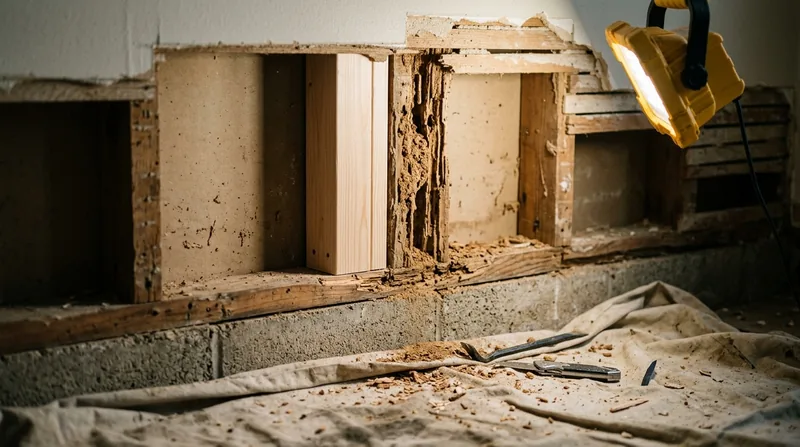




Eastern subterranean termites swarm across southwest Missouri every spring, and the older homes scattered through Springfield's historic neighborhoods, from the Queen Anne and Victorian porches of Walnut Street to the Craftsman bungalows near Missouri State, feel it hardest. These homes sit on stone foundations over damp crawlspaces and settle unevenly on the red clay and karst limestone of the Springfield Plateau, where moisture swings and freeze-thaw cycles keep wood vulnerable year-round. When a pest inspection confirms termite damage, the exterminator leaves but the eaten wood remains. We replace termite damage repair in studs, sills, trim, subfloor sections and floor joists, restoring full structural integrity so your home stands solid again. We work from your pest inspection report and build the repair right, not just cosmetically.
Why Termite Damage Repair Matters in Springfield's Older Homes
Springfield's building stock tells the story: 1880s-1910s Victorians with turned porch posts and tall wood windows, Craftsman foursquares under big oaks, modest wood-frame cottages on the north side, and 1950s-70s ranches over crawlspaces where termites breed in the damp. Eastern subterranean termites don't eat wood from the outside in, the way carpenter ants do. They tunnel from the soil upward through mud tubes, hollowing studs and sills from the inside while the surface paint stays intact. By the time you see damage, the wood is often already compromised. Structural members like floor joists and sill plates bear weight, so termite-eaten sections don't just look bad, they fail under load.
- We inspect the full extent of damage using your pest report and probe suspect areas to confirm the sound wood boundary.
- We replace compromised studs, joists, sill plates and subfloor sections with new pressure-treated or solid wood, sistering where repair is possible.
- We restore full load-bearing capacity so floors don't sag and walls don't settle unevenly.
- We work around active termite treatment, never interfering with your exterminator's protocol.
Leaving termite damage in place means watching a wall or floor weaken over time, risking uneven settlement, soft spots underfoot, and eventually costly structural failure.
Key info: Springfield homeowners in Rountree, Phelps Grove, and the historic districts often discover termite damage during spring inspections or when a floor feels soft near an exterior wall. The damage is real, the repair is straightforward, and the sooner you address it the less secondary rot from moisture sets in. Contact your local Springfield building department if your repair involves a load-bearing wall or structural beam, as permits may be required.
How We Repair Termite Damage: Our Process in Springfield
We start with your pest inspection report, which tells us where termites fed and what the exterminator found. We then probe the damaged areas to map the sound wood, because not all termite-eaten wood needs replacement. Studs that still carry their load, trim that's cosmetic, and small sections of subfloor can sometimes be reinforced. Structural members like floor joists, sill plates and rim joists almost always need replacement or sistering with new wood. We work methodically, often in stages, so you're not without a room or floor for weeks.
- We verify the damage location and depth using your pest inspection report and physical probing of suspect wood.
- We remove termite-eaten sections, cutting back to sound wood and exposing the repair area cleanly.
- We install new pressure-treated lumber for sill plates, rim joists and subfloor, or solid wood for studs and trim, matching the original dimension.
- We sister new joists alongside weakened ones where the wood can still carry part of the load, reinforcing instead of full replacement.
- We seal the repair against moisture and restore the surface finish or trim to match.
A typical job in a Craftsman bungalow near Phelps Grove might involve replacing a sill plate and two floor joists under a bay window, plus reinforcing a stud in the adjacent wall. We complete it in 2 to 4 days. For more information on related structural work, see our floor joist and subfloor repair page.
Local example: A homeowner in Springfield's Midtown district had termite damage confirmed in a sill plate and three floor joists under the dining room. We removed the damaged sections, installed pressure-treated replacements, and sistered new joists alongside the weakened ones. The floor is now solid, level, and the homeowner avoided the cost of full subfloor replacement.
Termite Damage Repair Methods: Repair vs. Replace
| Approach | Description | Best for |
|---|---|---|
| Full Replacement | Remove the entire damaged member and install new pressure-treated or solid wood of the same dimension. | Sill plates, rim joists, floor joists, studs that are more than 50% compromised by termite damage. |
| Sistering | Install a new joist or stud alongside the damaged one, bolting or fastening them together to share the load. | Floor joists and studs that retain 40 to 60 percent of their original strength and can share load with a new member. |
| Reinforcement Patches | Add blocking, plating or splice plates to damaged sections that are non-structural or carry minimal load. | Trim, fascia, exterior wood, and small areas of subfloor that are not part of the primary load path. |
| Staged Repair | Complete the repair in phases, working one room or section at a time so the home remains livable during work. | Homes with damage in multiple locations or where the homeowner needs to remain in the house during repair. |
Termite Damage Repair Cost in Springfield: What to Expect
Termite damage repair in Springfield typically starts at $1,200 for a small, localized repair, such as replacing one floor joist or a short section of sill plate in an accessible crawlspace. Larger jobs, involving multiple joists, studs or sill plates, or damage in hard-to-reach areas like under a porch or in a finished basement, run $2,500 to $5,000 or more. The cost depends on the extent of damage, the wood species and dimension, access difficulty, and whether sistering or full replacement is the right call. A Victorian home in Walnut Street with damage under a bay window costs more than a 1950s ranch in Southern Hills with straightforward crawlspace access.
We recommend getting 2 to 3 estimates so you can compare the scope of work and the approach each carpenter proposes. Some will recommend replacement where repair is possible, driving cost up unnecessarily. We explain what we find, show you the damage, and propose repair or replacement based on what the wood actually needs. For detailed pricing on all our carpentry services, visit our pricing page.
If your damage involves a structural beam or load-bearing wall, a licensed structural engineer is often required to size the replacement and approve the repair, and your local building department will require a permit. We handle the carpentry, but the engineer and permit are your responsibility to coordinate. Factor those costs and timelines into your budget if your damage is extensive.
What to Look for When Hiring a Termite Damage Repair Contractor Near Me in Springfield
A good carpenter in Springfield knows the local building stock and the way termite damage actually shows up in these older homes. Ask for references from other Springfield homeowners, especially those in your neighborhood or in a similar era home. Check that the contractor is fully insured and carries liability coverage for structural work. Get the repair scope in writing before work starts, so you know exactly what's being replaced, what's being repaired, and why. If your damage involves a structural member or a load-bearing wall, confirm that the contractor understands permit requirements and will work with your local building department or coordinate with an engineer if needed.
- Request at least two references from recent termite damage repair jobs in Springfield or nearby towns like Nixa or Ozark.
- Verify that the contractor is fully insured and ask to see the certificate of insurance before signing a contract.
- Get a detailed written estimate that lists the damaged members, the repair method, the materials, and the timeline.
- Confirm that the contractor understands local building codes and will obtain permits for structural work if required by your city.
- Ask how the contractor plans to work around your pest control treatment and whether there are any restrictions on timing.
Choosing a local carpenter who knows Springfield's homes and explains the work clearly saves you money and stress. Ready to get started? Contact us for a free estimate at (417) 815-0186, and we'll be in touch within 24 hours.
Termite Damage Repair in Springfield: Pricing Guide
| Service | Price | Details |
|---|---|---|
| Small localized repair | Starting at $1,200 | Single floor joist or short sill plate section replacement in accessible crawlspace or basement location |
| Medium repair job | Starting at $2,500 | Multiple joists, studs or sill sections, or damage under porches and finished areas requiring staged work |
| Large or complex termite damage | On estimate | Extensive damage across multiple structural members, load-bearing wall involvement, or engineer coordination required |
| Sistering or reinforcement | Starting at $900 | Reinforcing damaged joist or stud alongside existing member where wood retains sufficient load-bearing capacity |
| Travel and estimate | Free | No mileage fee within Springfield and surrounding service areas, response within 24 hours at (417) 815-0186 |
Indicative pricing, the exact cost depends on square footage, finish, and site access. Free personalized estimate within 24h at (417) 815-0186.


