The Springfield Climate and Your Doors
If you live in Springfield, you've probably noticed that your doors don't always close as smoothly as they did when you first moved in. This is no accident. The Ozark region experiences significant seasonal humidity swings, with summers bringing moisture-laden air and winters drying out the wood in your home's frame and doors. When wood absorbs moisture, it expands. When it loses moisture, it shrinks. Over time, this constant cycling causes doors to warp, twist, and bind against their frames.
The problem is especially pronounced in older homes, which are common throughout Springfield. Vintage wood doors and frames were often installed with tighter tolerances, meaning even small amounts of swelling can create a noticeable bind. Modern doors are sometimes manufactured with slightly more forgiving dimensions, but they're still vulnerable to humidity-related movement. Understanding that your sticking door is likely a symptom of a larger structural or moisture issue is the first step toward solving it properly.
How Humidity Causes Door Swelling and Binding
Wood is hygroscopic, which means it naturally absorbs and releases moisture based on the relative humidity of its surroundings. When humidity rises during spring and summer in Springfield, wood fibers swell. A door that fit perfectly in winter may refuse to close by July. This swelling happens unevenly across the wood's grain structure, which can cause the door to warp or cup, making the problem even worse. The top or bottom of the door may swell more than the sides, or the door frame itself may shift, throwing everything out of square.
The challenge is that humidity-related swelling is often temporary. If you plane or sand down a swollen door in July, come October when the air dries out, you may find gaps around the edges. This is why quick fixes like aggressive planing rarely work long-term. Instead, homeowners need to address the root cause: controlling indoor humidity levels and identifying whether there's an underlying moisture problem in the home's structure. If you're dealing with a door that won't close properly, it's worth investigating whether water is entering through the foundation, roof, or walls.
Foundation Settling and How It Throws Doors Out of Square
Another major culprit behind sticking doors in Springfield homes is foundation settling. Most homes experience some degree of foundation settlement over their lifetime, especially in the first five to ten years after construction. As soil compacts and the home's weight distributes, the foundation can shift slightly. In some cases, this shift is uniform and causes no problems. In others, settling is uneven, meaning one corner of the house drops slightly more than another. When this happens, the entire frame of the house goes out of square.
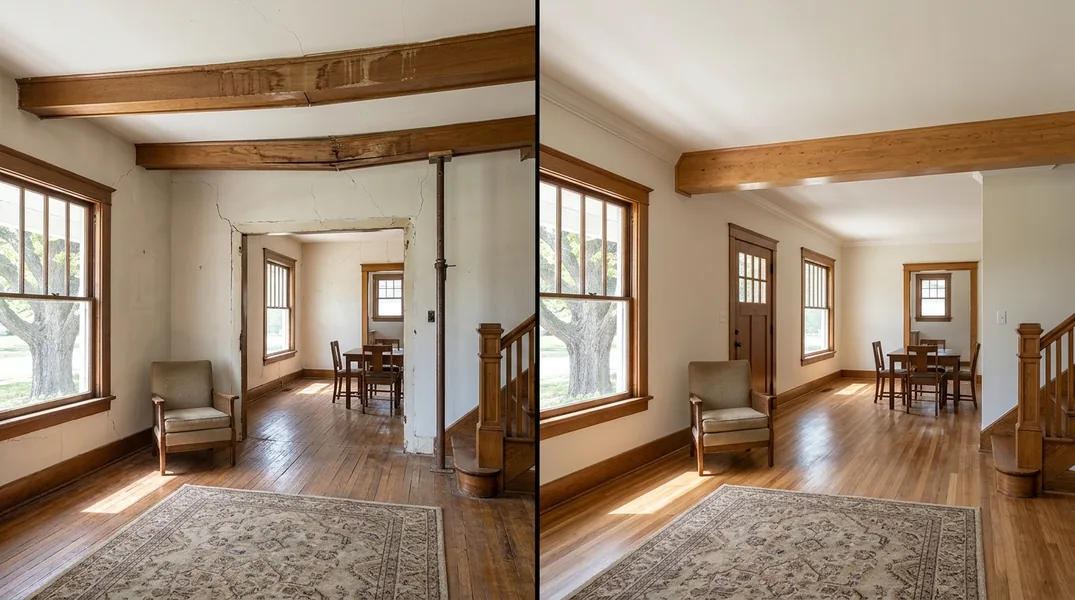
When your home's frame shifts out of square, the door frames follow. A door that hung perfectly plumb (straight up and down) may now be tilted. The top of the frame might be higher on one side than the other, or the sides of the frame might bow inward or outward. Even a quarter-inch of misalignment can cause significant binding. This is why adjusting hinges or planing the door provides only temporary relief. If foundation settling is the root cause, the real solution may require professional assessment of the foundation itself, and potentially structural repairs like Beam Replacement & Load-Bearing Wall Removal to restore the home to square.
Wood Rot and Dry Rot: The Hidden Culprit Behind Sticking Doors
While humidity and settling are common causes of sticking doors, there's another possibility that homeowners often overlook: wood rot or dry rot in the door frame itself or in the structural members that support it. If moisture has been entering your home through a roof leak, foundation crack, or poor drainage, the wood around your doors may be rotting from the inside out. Rotted wood loses its structural integrity and can warp, twist, or compress unevenly, throwing the door frame completely out of alignment.
Wood Rot & Dry Rot Repair is essential if you suspect this is the problem. Dry rot (also called wood decay fungus) is particularly sneaky because it can progress behind walls and door frames without obvious external signs. By the time you notice a sticking door, the rot may have already compromised the structural integrity of the frame or the surrounding wall. If you see soft spots in the wood around your door, notice a musty smell, or see discoloration or fungal growth, it's time to call a professional. Ignoring wood rot won't make it go away, and it will only get worse and more expensive to repair.
When to Call a Professional for Sticking Doors Near Me
If your door is sticking only slightly and the rest of your home seems structurally sound, you might try simple adjustments like tightening hinges or adjusting the strike plate. However, if the problem is persistent, affects multiple doors, or is accompanied by other signs of structural movement (like cracks in drywall, uneven floors, or visible wood damage), it's time to call in a professional. Springfield Carpentry has years of experience diagnosing and fixing sticking door problems throughout Springfield and the surrounding area.
A professional inspection will help determine whether you're dealing with a simple humidity issue, foundation settling, wood rot, or a combination of problems. Some situations require only minor adjustments, while others may indicate serious structural concerns that need immediate attention. If your home has experienced water intrusion, your door frames may need to be replaced entirely, or the underlying damage may require Floor Joist & Subfloor Repair or other structural work. Getting a professional assessment is the best way to understand what you're dealing with and what the real solution will cost.
Next Steps: Getting Your Doors Fixed
Don't let sticking doors become a permanent frustration in your Springfield home. The longer you wait, the more damage may be accumulating behind the scenes. Whether your problem is humidity-related, caused by foundation movement, or the result of wood rot, the solution starts with a thorough inspection from someone who knows Springfield homes inside and out.
Springfield Carpentry is ready to help. Contact us at (417) 815-0186 for a free estimate and let's figure out what's really causing your doors to stick. We'll give you an honest assessment of the problem and a clear explanation of your options. Don't settle for doors that don't work properly. Call today or visit our website to schedule your free estimate.
Looking for a professional carpentry contractor in Springfield? Springfield Carpentry responds fast for all your carpentry needs.
Get a Free QuoteOur services: Wood Rot & Dry Rot Repair · Termite Damage Repair · Floor Joist & Subfloor Repair